
Truss Method of Joints Example
Medium DifficultyFE Statics
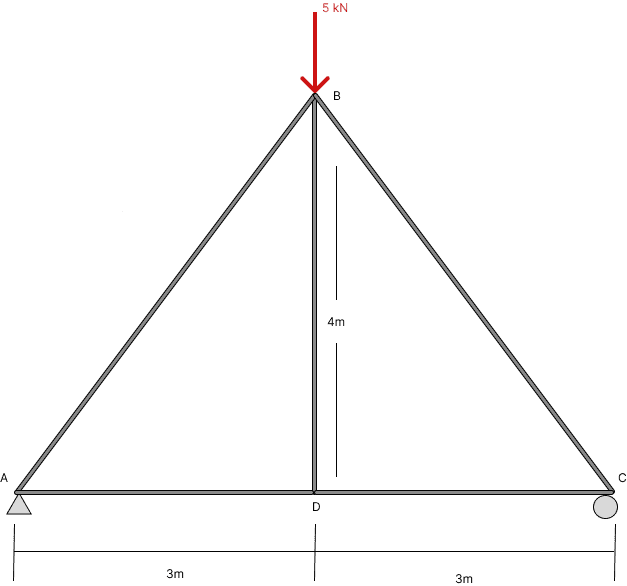
Find the force in each member of the truss. Identify tension and compression.
Concept
The method of joints analyzes trusses by isolating each joint and applying equilibrium equations. At each joint:
- Assume all members are in tension (forces pull away from the joint).
- Apply and .
- A negative result means the member is in compression.
- Start at a joint with at most two unknowns.
Key formulas:
Problem
A simple triangular truss has pin support at A, roller support at B, and a downward load at the apex C.
Find:
- Support reactions at A and B
- Force in each member (AC, BC, AB)
- Identify tension vs. compression
Given
- (span)
- (height)
- (downward at C)
Step 1: Support reactions
Treat the truss as a rigid body. Sum moments about A to find , then sum vertical forces to find .
Step 2: Joint A
At joint A we have two unknowns: and . Find the angle of member AC.
Step 3: Joint C
By symmetry of the truss and loading, member BC carries the same force as AC.
Final Answer
| Member | Force (N) | Type |
|---|---|---|
| AB | 3125 | Compression |
| BC | 3125 | Compression |
| CD | 1875 | Tension |
| BD | 0 | Zero-force |
| AD | 1875 | Tension |
Key Formulas
At each joint. Assume tension; negative result indicates compression.
Try This Problem Yourself in PolyCalc
Use PolyCalc calculators to try this problem yourself.
Try on Truss Calculator