
Maximum Bending Stress Example
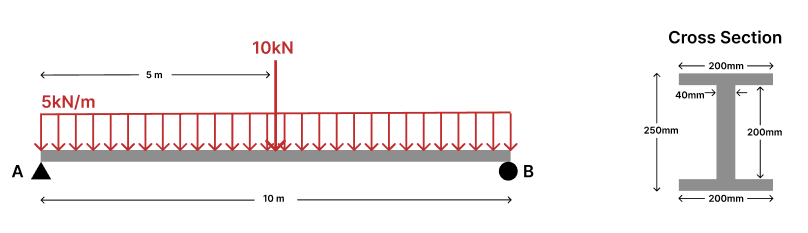
Find the maximum bending stress in a simply supported beam carrying a uniform distributed load and a center point load. The beam has an I-beam cross-section.
Concept
The flexure formula gives the bending stress at any point in a beam:
where = bending moment, = distance from neutral axis to extreme fiber, = moment of inertia. Maximum stress occurs where is largest and .
Problem
A simply supported beam of length carries a uniform distributed load over its entire span and a concentrated point load at midspan. The beam has an I-beam cross-section.
Find:
- Support reactions at A and B
- Maximum bending moment
- Maximum bending stress in the beam
Given
- (UDL, downward)
- (point load at midspan, downward)
- I-beam cross-section (from diagram): , , , ,
Support reactions (symmetry)
By symmetry, each support carries half the total load. Total load = .
Maximum bending moment
For a simply supported beam, the maximum moment occurs at midspan. The UDL and point load both contribute:
Distance from neutral axis to extreme fiber (c)
The neutral axis is at mid-height of the symmetric I-section. So is half the total depth:
Moment of inertia (I)
For the I-section, find about the horizontal centroidal axis by adding the web inertia and two flanges (using the parallel-axis theorem for each flange). All dimensions in mm; convert to m⁴ at the end.
(Flange centroid is from the NA.)
Maximum bending stress
Apply the flexure formula at the section of maximum moment. Maximum stress occurs at the extreme fibers where .
Final Answer
(1) Support reactions at A and B
(2) Maximum bending moment
(3) Maximum bending stress in the beam
At midspan, top and bottom fibers of the I-beam.
Key Formulas
where is the section modulus.
Try This Problem Yourself in PolyCalc
Use PolyCalc calculators to try this problem yourself.
Try on Beam Calculator