Maximum Shear Stress Example
Find the maximum shear stress in a simply supported beam carrying a uniform distributed load and a center point load. The beam has an I-beam cross-section.
Concept
The shear stress formula at a horizontal cut in a beam is:
where = shear force at the section, = first moment of area above (or below) the cut about the neutral axis, = moment of inertia of the full section, = width at the cut. For an I-beam, maximum shear stress occurs at the neutral axis (in the web).
Problem
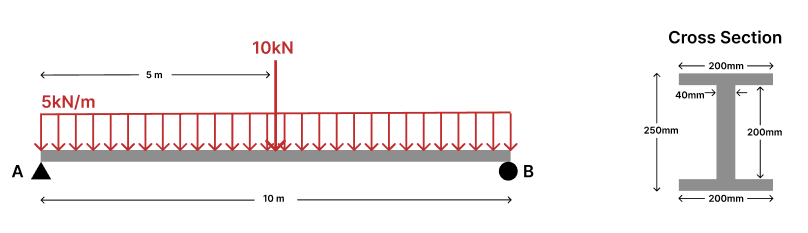
A simply supported beam of length carries a uniform distributed load over its entire span and a concentrated point load at midspan. The beam has an I-beam cross-section.
Find:
- Support reactions at A and B
- Maximum shear force in the beam
- Maximum shear stress in the beam
Given
- (UDL, downward)
- (point load at midspan, downward)
- I-beam cross-section (from diagram): , , , ,
Support reactions (symmetry)
By symmetry, each support carries half the total load. Total load = .
Maximum shear force
The shear force is largest at the supports. Just to the right of A, . Moving toward midspan, the UDL reduces the shear; the point load at midspan causes a step change. So the maximum magnitude occurs at the supports.
Moment of inertia (I)
Same I-beam as the bending stress example. From the cross-section dimensions (web + two flanges with parallel-axis theorem), the moment of inertia about the neutral axis is:
First moment of area (Q) at the neutral axis
For maximum shear stress at the NA, take the area above the neutral axis. This is the top flange plus the part of the web above the NA. , where is the distance from the NA to each sub-area centroid.
(Top flange: area 200×25 mm², centroid 112.5 mm above NA.)
(Web above NA: 40×100 mm², centroid 50 mm above NA.)
Maximum shear stress
At the neutral axis, width . Apply the shear formula with , and convert units to N and m for in Pa (then MPa).
Final Answer
(1) Support reactions at A and B
(2) Maximum shear force in the beam
(3) Maximum shear stress in the beam
At the neutral axis, in the web of the I-beam.
Key Formulas
Try This Problem Yourself in PolyCalc
Use PolyCalc calculators to try this problem yourself.
Try on Beam Calculator